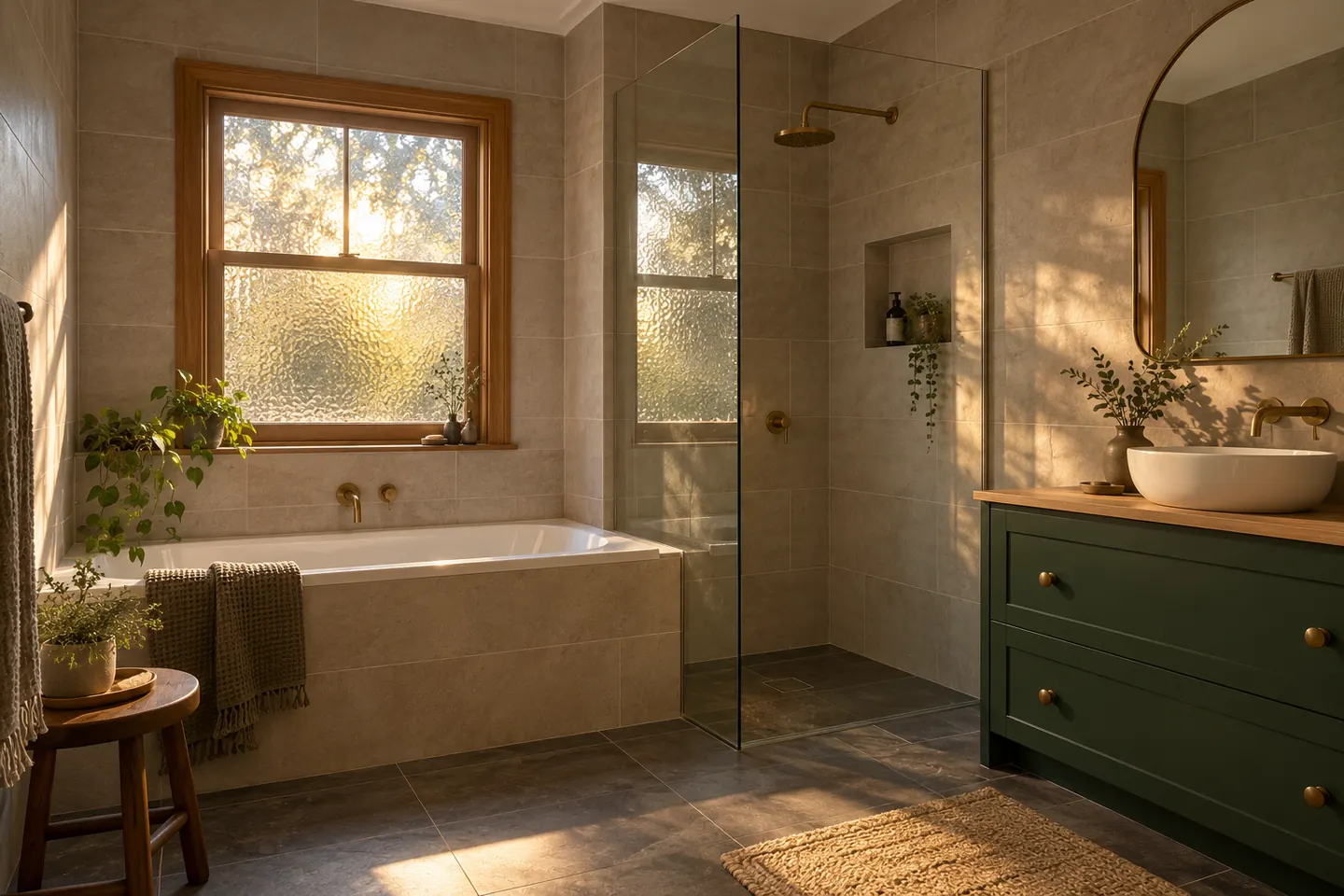
The town in the middle
Springwood is the practical centre of the mid mountains: the shops, the station, the medical and school services that the surrounding towns use. It is high enough for real winters, low enough to avoid the worst of the frost, and close enough to everywhere between Glenbrook and Lawson that it makes sense as a base.
That matters more than it sounds. The mountains are a long thin strip, and the single biggest hidden cost in renovating up here is travel time between jobs. Working outwards from Springwood is how a small trade team stays efficient, which is how a quote stays honest.
The housing, and what it means for a bathroom
Federation and inter-war cottages, mostly near the older part of town. Timber floors over a subfloor, high ceilings, original trim worth keeping. The bathroom is often an early conversion of a back room or an enclosed verandah, which means it was never designed as a wet area and frequently shows it once the sheeting comes off.
Post-war fibro and weatherboard, from the forties through the sixties. Small bathrooms, often with a separate toilet next door, thin uninsulated walls and a fan that vents into the roof if there is one at all. These rooms benefit enormously from being replanned as one space.
Brick and brick veneer from the seventies and eighties, often on larger bush blocks away from the centre. Generally sound, generally dated, usually on a slab, and often a good candidate for a partial upgrade: new vanity, tapware, screen, lighting, mirror and heating, with the tiles and membrane left alone if they are still good.
What we end up doing most often here
The common Springwood brief is not glamorous and it is a good one: make the room warm, dry and easy to clean, and stop the mould coming back.
In practice that is a ducted exhaust fan sized for the room and run on a timer, insulation batts above the bathroom ceiling while it is open, underfloor heating or a heated towel rail, full-height tiling so there is no painted band to peel, and a step-free shower that drains properly instead of holding water along a hob.
The full bathroom renovation page explains how that is built, and waterproofing and tiling covers the part that decides whether it lasts.
Timber floors are an opportunity
Because so much Springwood housing sits on a timber subfloor, moving plumbing is realistic. A badly planned cottage bathroom can usually be completely rethought — toilet relocated, shower enlarged, vanity moved off the door swing — for a fraction of what the same change would cost on a slab.
The trade-off is that the floor has to be assessed honestly. Soft timber near an old shower waste, borer in a bearer, inadequate joist spacing for tiling: all of it gets found during the strip-out, and all of it is priced as a written variation rather than discovered on an invoice.
Asbestos and older homes
Homes built or renovated before 1990 can contain asbestos in wet-area wall sheeting, eaves, vinyl floor coverings and the adhesive beneath them. Springwood has plenty of that era. Bathrooms are tested before demolition and any removal is carried out by a licensed asbestos removalist.
Bush blocks and bushfire-prone land
Much of the housing here backs onto bush. Some lots are mapped as bush fire prone, which does not usually affect internal bathroom work but can affect external windows and doors if a renovation replaces them. Check the property's status with Blue Mountains City Council before ordering anything, and treat any general statement about ratings as a prompt to check rather than an answer.
Cost and getting started
Costs depend on the room, the floor, the era of the house and your selections — see the cost page for the planning tiers and what moves them, or the process page for the program. A free on-site measure takes about forty minutes and produces a fixed written quote.
Renovation work is carried out in partnership with Coastal Renovation Group, a licensed NSW builder; licence and insurance details are provided on request.
Call 02 4705 3295 or send the room details through.