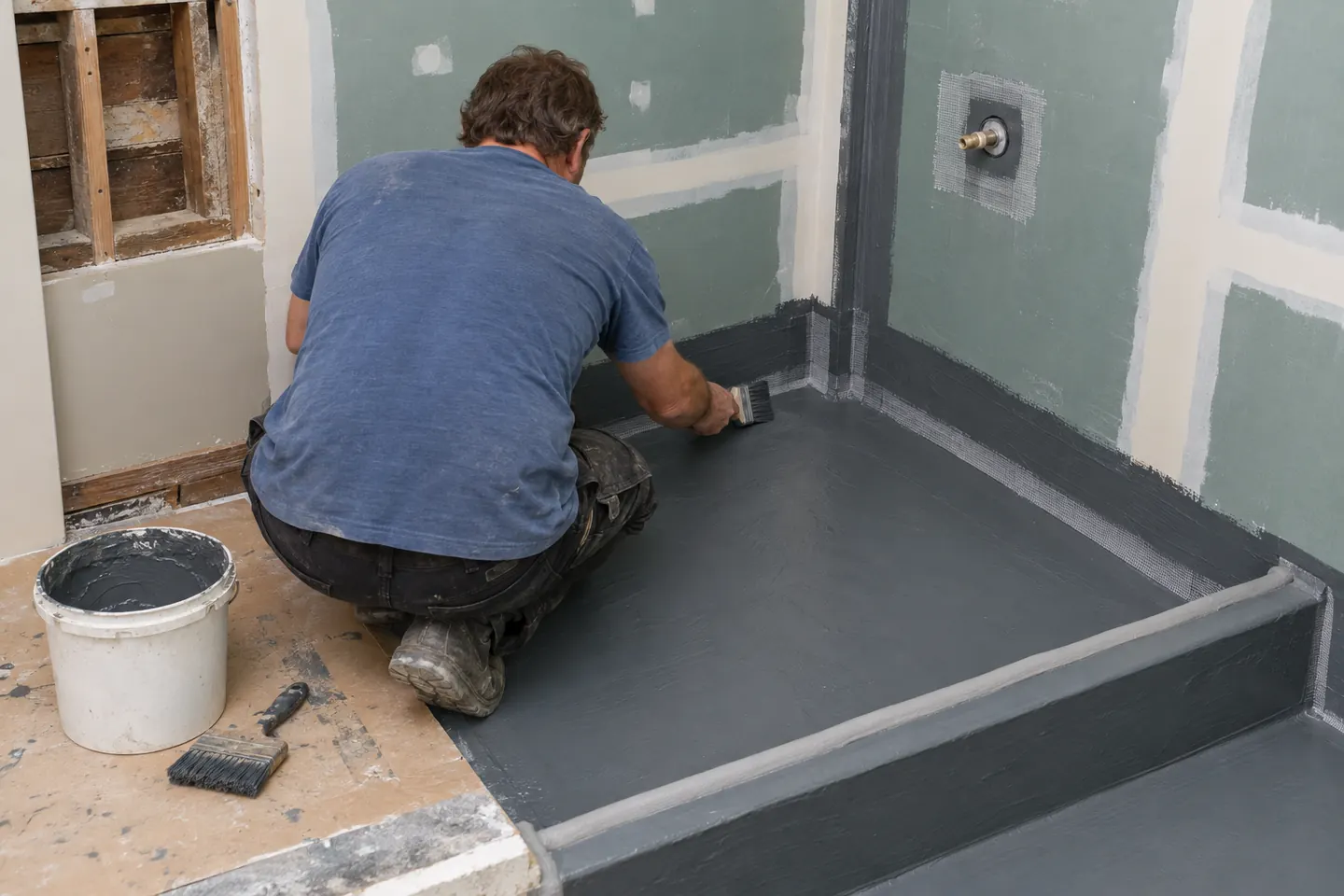
Why this gets its own page
Nearly every failed bathroom we are asked to look at failed in the same place: the membrane, the falls, or the junction between the two. Not the tiles. Not the tapware.
In a cold, damp climate the margin is thinner again. Surfaces stay wet longer, grout dries slower, movement between a cold night and a heated morning is greater, and a slow leak into a timber subfloor has months of winter to do its work before anyone notices a stain.
How the work actually goes
The substrate is made right first. Loose sheeting replaced, soft timber cut out, floors stiffened, and the surface cleaned and primed. A membrane is only as good as what it is stuck to.
Falls are formed before the membrane. A screed is laid to fall to the waste, with the grade checked across the whole shower area, not just near the drain. In a step-free shower this is where the job is won or lost.
Bond breakers and flashings go in. At every internal corner, every wall-floor junction and around the waste, because those are the points that move.
The membrane is applied in coats, with cure time between them. Product, coats and the areas treated are recorded.
It is flood tested or inspected before tiling. Then — and only then — the tiler starts.
A certificate is issued and handed over with the job.
Cold weather and cure times
This is the part that separates a careful job from a fast one. Waterproofing membranes have a minimum application temperature and a cure time that lengthens as the temperature drops and humidity rises. Through a mountains winter both work against you.
The honest consequence is that a bathroom here can take a few days longer in July than the same bathroom would in February, and a program that pretends otherwise is either tiling over a green membrane or running heaters hard enough to cause their own problems. We would rather tell you the date moved than find out in two years.
Tiling that suits the house
Floor falls and tile size. A large-format tile cannot follow a complex fall. In a step-free shower, smaller floor tiles or a linear waste with a single-direction fall usually give a better result.
Slip resistance. The shower floor and the room floor are specified with an appropriate slip rating for a wet area, which matters even more where people come in from frosty paths. See accessible bathrooms.
Movement joints. Where tiles run over a change of substrate, around the perimeter and in large areas, a flexible joint absorbs movement that would otherwise crack grout.
Grout and silicone. Chosen for a wide temperature range. Silicone at the internal corners and the floor junction, grout everywhere else — not the other way around, which is a common shortcut.
Period tiling. Square-format wall tiles, simple mosaic floors and traditional patterns suit the older houses up here, and the setting-out is planned so cuts land where they are least obvious. See small bathrooms and full renovations.
Leaks in an existing bathroom
If an existing shower is leaking, the first job is diagnosis rather than demolition. Sometimes it is a failed silicone joint, a cracked waste, a shower screen sealed on the wrong side or a tap body leaking behind the wall. Those can be repaired. If the membrane itself has failed, or there is none, re-tiling over the top only buys time.
Where a leak has been running into a timber floor, the extent of the damage is confirmed before a price is given.
Asbestos
Wet-area sheeting in homes built or renovated before 1990 can contain asbestos. It is tested before any demolition, and removal is carried out by a licensed asbestos removalist, not by a tiler.
Cost and next steps
Waterproofing and tiling are part of every full renovation we arrange and can also be quoted for a room that is otherwise sound. The cost page explains how tile format, tiling height and floor construction move the price, and the process page shows where this stage sits in the program.
The deposit on residential building work in NSW is capped at 10 per cent of the contract price. Renovation work is carried out in partnership with Coastal Renovation Group, a licensed NSW builder; licence and insurance details are provided on request.
Call 02 4705 3295 or send the room details through.