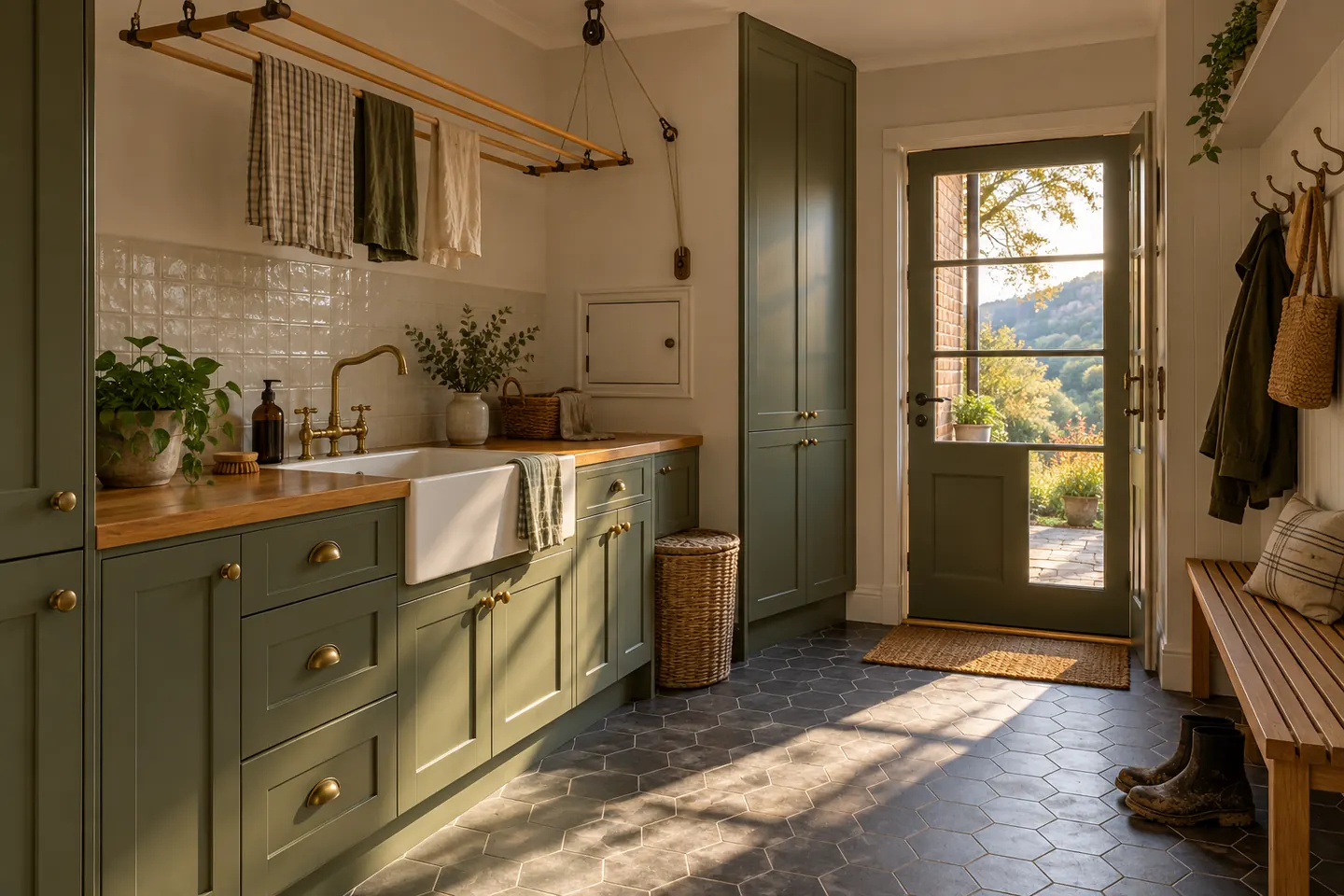
What a mountains laundry has to cope with
Four months of the year, clothes do not dry on a line. Boots come in wet from a bush track or a gravel driveway. Firewood leaves bark and dust. Towels come off a cold bathroom rail still damp. Dogs come back from the reserve filthy.
That is a different brief from a laundry in a warm, dry suburb, and it is why the three things people ask for most here are bench space, storage and somewhere to dry things indoors without wetting the whole house.
The layout that works
Bench over the appliances, or beside them. Somewhere to sort, fold and leave a basket. A front loader under a continuous benchtop is the usual way to get it; a top loader needs the bench beside instead.
A deep tub, plumbed properly. For soaking, for buckets, for washing out a boot. A shallow moulded tub looks neat and disappoints immediately.
Tall storage. Brooms, the vacuum, the mop and the bucket need a cupboard, not a corner.
A drying zone. A ceiling-mounted airer on a pulley, or a wall rack that folds flat, positioned over a hard floor with a fall or at least a water-tolerant surface. Pair it with ventilation or the damp simply moves into the ceiling.
A hard-wearing floor. Porcelain, a quality vinyl plank rated for wet areas, or sheet vinyl with coved edges. It will have mud, grit and water on it constantly.
A bench or hooks at the door if the laundry is also the way in from the back yard. Boots off at the door is how the rest of the house stays clean.
Ventilation and damp
A laundry producing moisture in a cold house is a mould problem waiting to happen. The practical measures are the same ones that work in the bathroom:
- An exhaust fan ducted outside, on a timer, especially where clothes dry indoors
- A condenser or heat pump dryer drained to waste, or a vented dryer ducted outside rather than into the room
- Insulation above the ceiling where it is open
- A door that seals, so laundry humidity does not drift through the house
- Where the laundry sits over an open subfloor, enclosing or insulating that space
Appliances, taps and the small details
Isolating taps that can actually be turned off by hand. Braided hoses replaced rather than reused. A floor waste where the layout allows it, because a hose does eventually let go. A powerpoint that is not behind the machine where nobody can reach it. These are the things people notice in the second year.
Benchtops
Engineered stone has been banned in Australia since 1 July 2024 and is not used. A laundry bench is a good place for a hard-wearing laminate, a solid timber top that is properly sealed, or porcelain. If you like the look of timber in a wet room, read what actually lasts — the same material reasoning applies to a laundry bench over a tub.
Older homes
Fibro and weatherboard homes often have the laundry in a lean-to, under the house, or on an enclosed verandah. Those spaces are usually uninsulated, sometimes unlined, and frequently have a floor that has been wet for decades. Expect the strip-out to find things. Pre-1990 sheeting is tested for asbestos before demolition and removal goes to a licensed removalist.
Approvals
An internal laundry renovation that stays in the same room is generally exempt development. Enclosing a verandah, adding a room or changing the outside of the house is not, so check with Blue Mountains City Council first.
Cost and next steps
A laundry done alongside a bathroom is the most economical way to get one, and most laundries sit in the lower planning tiers on the cost page. A free on-site measure gives a fixed written quote.
The deposit on residential building work in NSW is capped at 10 per cent of the contract price. Renovation work is carried out in partnership with Coastal Renovation Group, a licensed NSW builder; licence and insurance details are provided on request.
Call 02 4705 3295 or send the room details through.